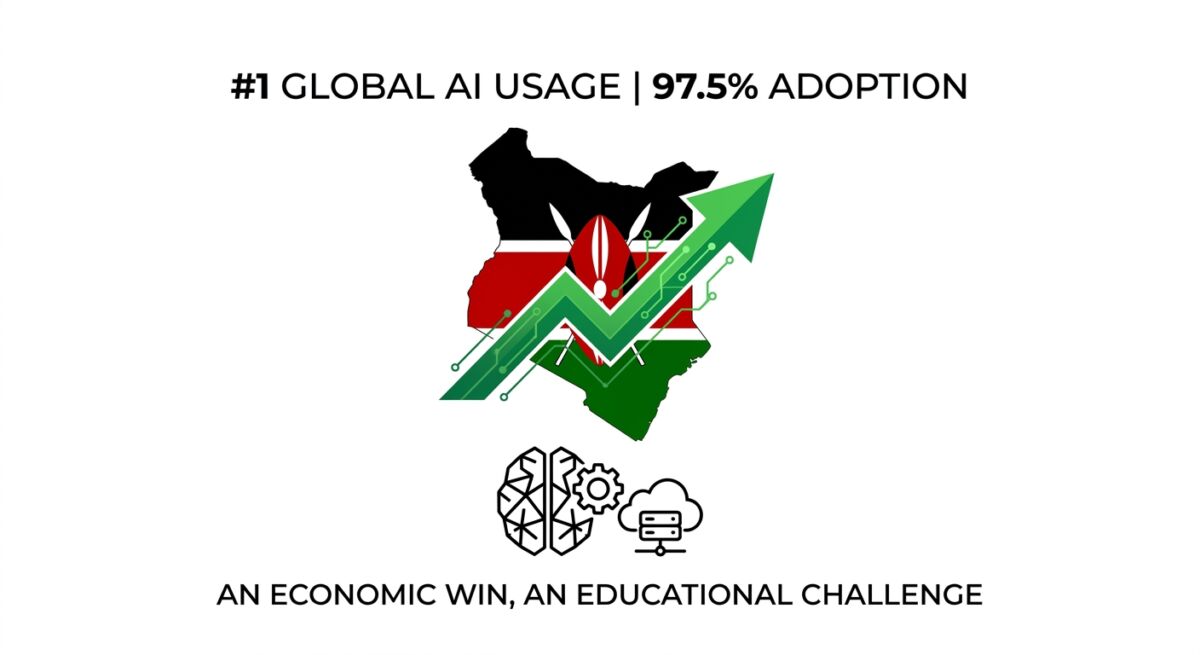
Global Update Report—compiled by DataReportal alongside We Are Social—Kenya outperforms every other surveyed market, ahead of the United Arab Emirates at 94.2 percent and Indonesia at 93.6 percent. The figure stands in stark contrast to mature Western economies, where monthly usage sits at 71.5 percent in the United States and 62.8 percent in the United Kingdom.
The rapid adoption reflects a tech ecosystem built on widespread mobile internet access, cheap data packages, and an unusually high concentration of remote digital workers. Over the past decade, Nairobi has served as a primary hub for global AI data annotation, with thousands of young workers training, labeling, and fine-tuning language models for Silicon Valley firms. That background, combined with early enterprise implementation—such as Safaricom integrating predictive AI into M-Pesa fraud detection and customer support—has normalized generative tools faster than in markets constrained by legacy corporate software policies.
However, the statistic masks a growing structural concern within Kenya’s education and labor sectors: the widespread substitution of critical reasoning with automated output. Educators and cognitive researchers note that while access to AI boosts short-term task execution, heavy reliance among high school and university students is triggering systematic “cognitive offloading”. Across academic institutions, faculty report a noticeable decline in students’ baseline writing mechanics, long-form reading comprehension, and independent problem-solving skills, as users increasingly outsource research synthesis and analytical drafting to generative models.
The economic implications are equally complex. While freelance professionals, software developers, and small business operators use AI to compress project timelines, the technology is primarily being consumed rather than produced locally. The vast majority of platforms powering Kenyan workflows—from ChatGPT and Claude to embedded workspace utilities—are owned by foreign entities, meaning local users generate data value for overseas platforms without building domestic intellectual property.
The report arrives as the Ministry of Information, Communications and the Digital Economy concludes public consultations on the draft Kenya Artificial Intelligence and Other Emerging Technologies Policy 2026. Lawmakers face the immediate challenge of framing guardrails that protect educational standards and local talent development without stifling the digital agility that put the country at the top of the global index.

A strong society relies on accessible healthcare and solid education. I focus my writing on the challenges and victories within our schools and clinics, keeping the focus on community well-being.