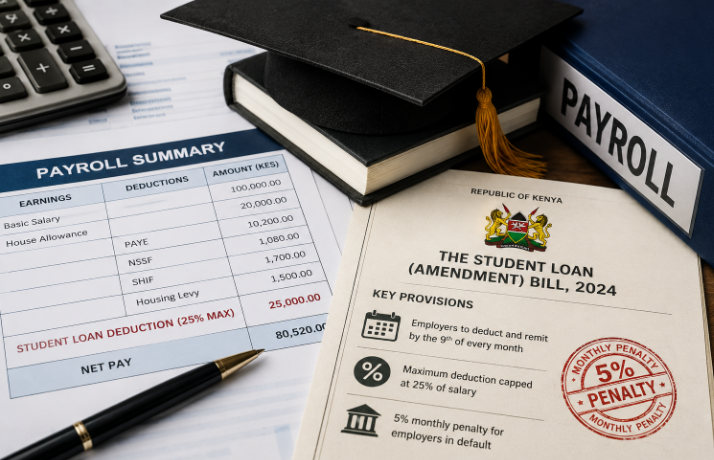
Draft legislation seeking to overhaul student loan recovery in Kenya proposes placing direct legal and financial responsibility on employers to collect and remit repayments from working graduates.
Under the provisions of the proposed Bill, employers will be legally mandated to deduct student loan repayments from eligible staff salaries and remit the funds by the 9th day of every succeeding month. To cushion workers from excessive salary erosion, the Bill caps individual monthly deductions at 25% of an employee’s pay. However, companies that fail to comply, delay remittances, or neglect to declare eligible employees will face a monthly penalty of 5% on the outstanding amount.
The proposal represents a deliberate legislative effort to harmonize student loan recovery with Kenya’s primary statutory payroll timeline. Currently, major statutory deductions—including Pay As You Earn (PAYE), National Social Security Fund (NSSF), Social Health Insurance Fund (SHIF), and the Affordable Housing Levy—are tied to the 9th-of-the-month deadline. Bringing student loan remittances into this single compliance window eliminates previous leeway where recoveries stretched to the 15th, forcing corporate finance departments to streamline their monthly payroll processing.
For Kenya’s formal workforce, the 25% ceiling establishes a statutory safeguard against arbitrary or aggressive loan recovery attempts that previously left some workers with diminished paychecks. By defining a clear upper limit, the legislation attempts to strike a balance between aggressive public debt collection and basic livelihood protection for employed graduates.
However, the burden of enforcement shifts heavily onto the private sector. Small and medium-sized enterprises (SMEs), which already navigate a complex multi-agency tax regime, will absorb additional operational costs. The 5% monthly penalty creates significant financial risk for companies struggling with cash flow, as delayed salary processing will automatically trigger statutory fines from the recovery board.
What Evidence Shows & What Remains Unclear
While the core mechanics of the Bill are clearly defined—the 9th-day deadline, the 25% deduction ceiling, and the 5% employer penalty—several operational and legal questions remain unaddressed in the current draft:
- Employee Disclosure Mechanisms: The Bill does not explicitly outline how employers will independently verify whether new hires carry outstanding student loans if the employee does not voluntarily disclose their debt status.
- Tax Relief Status: It remains unconfirmed whether student loan repayments will qualify for pre-tax relief status, similar to mortgage interest or pension contributions, or if they will be deducted strictly from net earnings.
- SME Grace Periods: The current text makes no distinction between multinational corporations and small enterprises regarding implementation timelines or relief from initial non-compliance penalties.
The Bill is expected to move to the public participation phase, where business associations, labor unions, and higher education stakeholders will submit formal feedback. Corporate leaders and human resource practitioners are likely to push for clearer guidelines on data-sharing between government recovery boards and private payroll systems to avoid penalizing companies for unlisted student debtors.
If enacted in its present form, businesses will have to audit their payroll software and compliance schedules immediately to avoid compounding monthly fines once the law takes effect.

A strong society relies on accessible healthcare and solid education. I focus my writing on the challenges and victories within our schools and clinics, keeping the focus on community well-being.