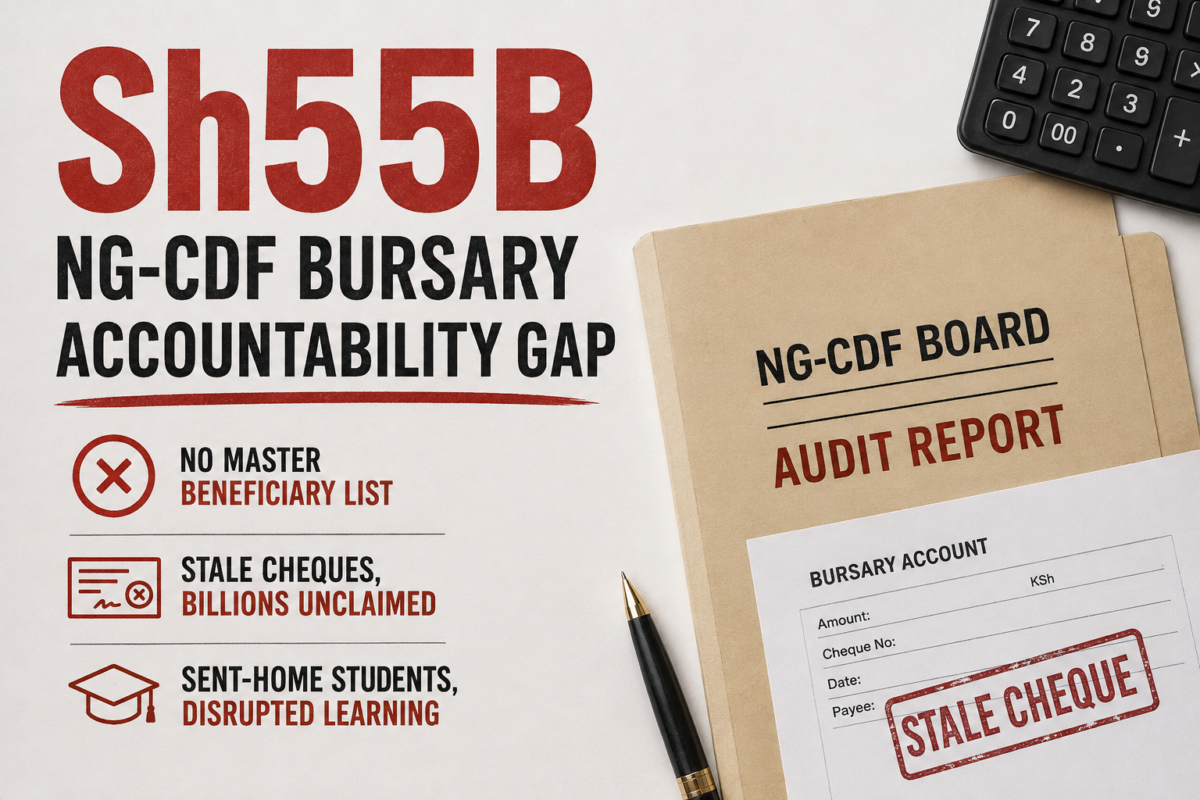
Kenya’s constituency-based education safety net is operating without basic financial tracking, leaving billions of shillings unaccounted for and thousands of needy students facing classroom exclusions. A performance audit by Auditor-General Nancy Gathungu reveals that despite spending Sh55.72 billion on student bursaries and scholarships over five years, the National Government Constituency Development Fund (NG-CDF) Board cannot verify whether targeted beneficiaries actually exist or received the money.
The audit paints a clear picture of administrative weakness across the country’s 290 constituencies. While Parliament allocated Sh243 billion to the NG-CDF pool over the audited period—with nearly a quarter earmarked for education grants serving an estimated 4.9 million learners—the central board failed to establish a master beneficiary database. Without a centralized national record, oversight bodies cannot verify disbursements, preventing checks against double allocations, ghost students, or local political patronage.
Beyond missing records, the audit highlights operational delays that directly undermine the program’s primary objective of keeping vulnerable children in school. Bursary disbursements consistently arrive months late, completely misaligned with the national academic calendar. As a result, headteachers regularly send students home for unpaid fees—particularly in day secondary schools where families rely on public support—disrupting learning cycles and increasing dropout risks.
Financial control is further weakened by a continued reliance on physical paper cheques. According to the audit, 285 out of 290 constituencies still process bursary applications manually. Cheques frequently sit uncollected in constituency offices, go missing in transit, or expire into stale instruments. In just five sampled constituencies during a single financial year, auditors uncovered more than Sh722 million tied up in unpresented cheques—funds capable of fully funding annual tuition for over 18,000 secondary school students.
Accountability breaks down completely once money leaves constituency bank accounts. The report notes that learning institutions regularly fail to issue official receipts or acknowledgment letters confirming that funds deposited were credited to specific students’ fee balances. Combined with inadequate follow-up field visits by constituency committees, the NG-CDF Board lacks a verifiable paper trail to prove that public funds reached genuine classrooms.
The audit points to administrative inertia at the executive level as a primary driver of the problem. Only five constituencies—South Mugirango, Uriri, Mwala, Gatanga, and Emgwen—have fully digitized their bursary processing systems. The central NG-CDF Board has failed to mandate or fund digital infrastructure across the remaining 285 constituencies, leaving the application process bound to physical paper forms that disadvantage students studying far from their home districts or those living with disabilities.
With the legal framework of the NG-CDF facing ongoing judicial scrutiny regarding public finance management, Gathungu’s findings put renewed pressure on Parliament to enforce structural reforms. Until the fund digitizes its operations, institutes a central beneficiary registry, and aligns releases with school terms, Kenya’s multi-billion-shilling education safety net will continue to operate largely in the dark.

Numbers tell a story, but only if you know how to listen to them. I focus on making sense of the shifting economy, keeping track of where the money goes and how it impacts daily lives.