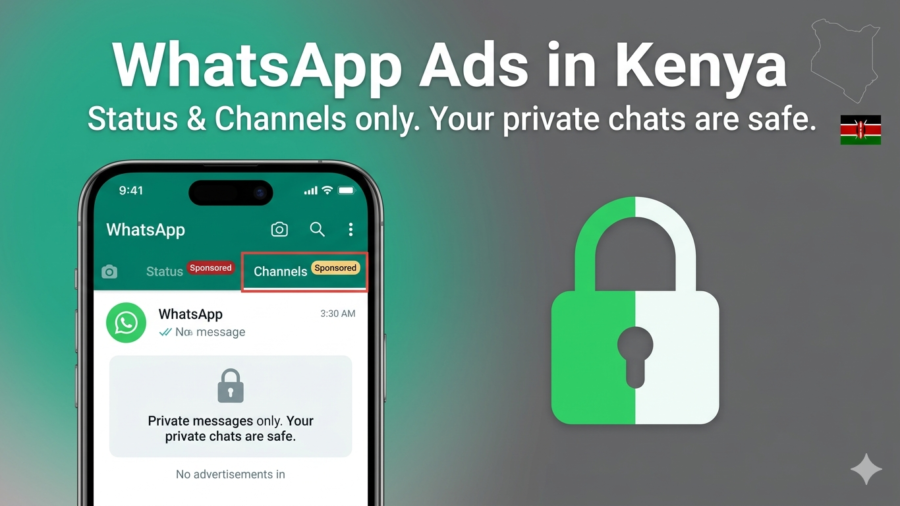
Here’s where the ads appear, why Meta chose Kenya, and what stays encrypted.
If you’ve opened WhatsApp on your phone in Kenya recently, you might have noticed something new. Ads have started appearing in the Status and Channels tabs. Yes, ads – inside WhatsApp.
Before you panic, here’s the most important part: Your personal chats, calls, and messages remain private and end-to-end encrypted. Meta is not putting ads inside your conversations. Not now. Not in this rollout.
So where exactly are these ads? Why Kenya? And should you be worried? Let’s break it down.
Where Are WhatsApp Ads Appearing in Kenya?
Meta has chosen two specific, public-facing areas of WhatsApp for advertisements. Neither of them is your inbox.
First, the Status tab. If you use WhatsApp Stories (called Status), you’ll now see sponsored vertical updates from businesses. They look similar to your contacts’ statuses but are labeled “Sponsored.” You can tap to view or simply scroll past.
Second, the Channels tab. Channels are public broadcasts from organizations, news outlets, or creators you choose to follow. Ads now appear within the Channels directory and feed, helping businesses promote their channels to reach more people.
What you will NOT see: Ads inside your one-on-one texts, group chats, or voice and video calls. Those remain completely ad-free.
Why Did Meta Choose Kenya for WhatsApp Ads?
Kenya is not a random test market. Meta has a strategic reason for rolling out ads here first.
-
Over 90% of smartphone users in Kenya are on WhatsApp. It’s the primary messaging app for personal and business communication.
-
WhatsApp Business is already massive. Millions of Kenyan small businesses use WhatsApp to talk to customers. Advertising is a natural next step.
-
Mobile-first economy. Kenyans are already comfortable with mobile payments (M-Pesa) and mobile ads. Testing here gives Meta real-world data before a global launch.
If the Kenyan rollout succeeds, expect to see WhatsApp ads spread to other countries.
Your Private Chats Are Still Safe – Here’s the Proof
Meta has been very clear on this point, and it’s worth repeating: Personal messages, calls, and media remain end-to-end encrypted.
That means:
-
No Meta employee can read your chats.
-
No advertiser can see your private conversations.
-
No government can access your messages without your device (under current encryption standards).
The ads live only in public or semi-public spaces – Status updates (which disappear in 24 hours) and Channels (which are public broadcasts). Your private threads are untouched.
This distinction is critical. WhatsApp is not becoming Facebook’s cluttered news feed. It is adding ads to separate tabs that function more like social media than messaging.
How Will This Affect You as a Kenyan User?
For the average person, the change is minor – unless you spend a lot of time watching Status updates or browsing Channels.
You will see: A “Sponsored” status once in a while. Maybe a promoted channel suggestion.
You will not see: Pop-ups, banner ads, or interruptions while typing a message.
Currently, you cannot disable these ads entirely. But you can ignore them. Meta has not announced a paid, ad-free tier for WhatsApp in Kenya – at least not yet.
For businesses, this is a new opportunity. You can now run ad campaigns on WhatsApp using Meta’s Ads Manager (the same tool for Facebook and Instagram ads). Targeting options include location (Nairobi, Mombasa, Kisumu), interests, and behaviors – but again, no private chat data is used.
What Do Kenyan Users Think So Far?
Early reactions on social media are mixed – and that’s normal for any major change.
Some users are frustrated. “I just want to text my family without ads,” one X user wrote. Others worry this is the beginning of a slippery slope toward a cluttered app.
But many business owners and digital marketers see the upside. “If I can reach customers directly on WhatsApp without spamming groups, that’s huge for my small shop,” a Nairobi-based seller commented.
Privacy advocates are watching carefully. While Meta promises encryption remains intact, critics ask: Will engagement with ads influence what users see elsewhere on Facebook or Instagram? That answer is still unclear.
What Should You Do Now?
You don’t need to delete WhatsApp or change your habits overnight. But here are three practical steps:
-
Check your Status and Channels tabs over the next week. You’ll likely see your first sponsored post soon.
-
Review your privacy settings in WhatsApp (Settings > Privacy). Nothing has changed regarding encryption, but it’s always good practice.
-
Share your feedback. Meta monitors user reactions. If ads become intrusive, letting them know – or simply not clicking – sends a signal.
The Bottom Line
WhatsApp ads in Kenya are real, but they are limited to Status and Channels. Your private, encrypted chats are untouched. Meta chose Kenya as a test market because of high usage and a mobile-first economy.
For most users, the experience will remain largely the same – just with an occasional sponsored story. For businesses, it’s a new advertising channel. For privacy advocates, it’s a development worth watching.
One thing is certain: WhatsApp is no longer just a messaging app. It’s becoming a platform. And Kenya is the first to see what that looks like.
Have you seen a WhatsApp ad in your Status tab yet? Share your experience in the comments – or tell us if you think this is a good move or a bad one.