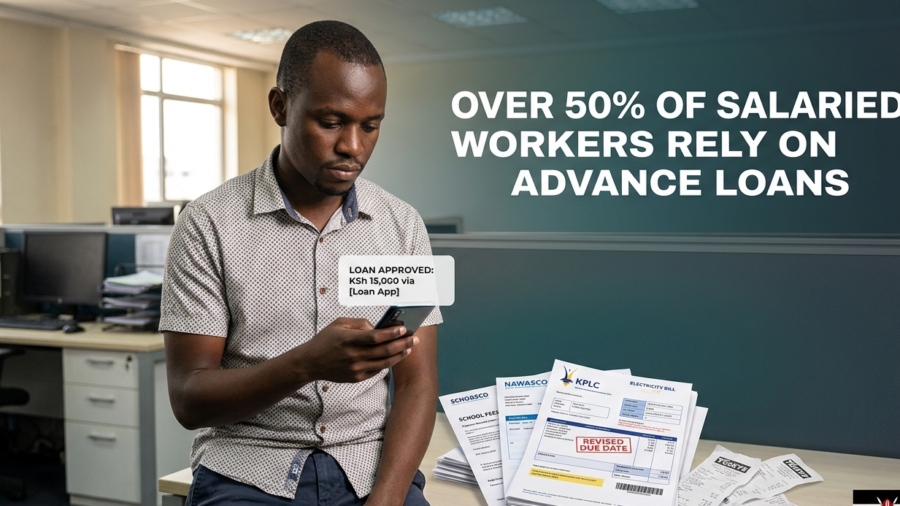
A new report reveals that rising living costs have pushed millions of employees into reliance on short-term credit.
More than half of Kenya’s salaried workers—across both public and private sectors—now rely on advance loans to get by. The finding comes from a recent report by digital lending company UNIFI, which paints a stark picture of financial distress among employed Kenyans.
Delayed wages, shrinking real incomes, and a relentless rise in basic commodity prices have forced many households to seek short-term credit simply to cover monthly expenses. The report confirms what many workers already know: the salary that once lasted the month now barely stretches two weeks.
Why Are So Many Workers Turning to Advance Loans?
The primary driver behind this trend is Kenya’s persistently high cost of living. While headline inflation hovered around 4.5 per cent in late 2025, the prices of essential goods have surged far more dramatically.
According to recent data, food and non-alcoholic beverages rose by 7.7 per cent year-on-year. Transport costs climbed by 5.1 per cent. Specific items tell an even starker story: the price of tomatoes jumped 37 per cent in just one year.
A worker who could buy groceries for KSh 3,000 a year ago now needs nearly KSh 4,000 for the same basket of goods. Meanwhile, statutory deductions—including the 1.5 per cent housing levy—have further squeezed take-home pay. The result is less disposable income at the end of every month, pushing employees to borrow just to survive until the next payday.
The Digital Lending Boom
Traditional banks have largely ignored the short-term, small-ticket loan market. Into that gap has stepped a rapidly expanding digital lending sector. As of September 2025, the Central Bank of Kenya had licensed 153 digital credit providers, with over 700 applications still under review.
UNIFI itself has served 25,000 clients in Kenya since 2022. The company reports a significant uptake in digital loans, which it attributes directly to harsh economic times and delayed salary remittances from both public and private employers.
Gloria Kamotho, UNIFI’s Communication Officer, explained that most clients seeking advances face genuine financial constraints between paydays. “The advance loan is meant to make life easy for that parent who, in between the months, wants to complete their child’s fees and sort out that medical bill for their loved one,” she said.
The Regulatory Landscape
The Central Bank of Kenya has taken steps to formalise the digital lending sector, which previously faced widespread criticism for predatory practices, opaque terms, and exorbitant interest rates. By June 2025, licensed digital lenders had disbursed 5.5 million loans worth KSh 76.8 billion.
However, challenges remain. Gys Steyn, UNIFI’s country manager, noted that many employees want a trusted partner that understands their financial struggles and does not take advantage of their vulnerability. “Workers need a lender who offers reasonable terms, not one that pushes them deeper into debt,” he said.
The CBK continues to review hundreds of pending licence applications, aiming to balance financial inclusion with consumer protection.
The Bottom Line
The UNIFI report confirms a sobering reality for Kenyan workers. The rising cost of living has made it increasingly difficult to stretch a salary from one month to the next. Over half of all salaried employees now depend on advance loans—not for luxuries, but for basics like food, school fees, and medical bills.
Until wages meaningfully rise or essential goods become more affordable, this trend is unlikely to reverse. In the meantime, workers are urged to borrow cautiously, verify lender licences, and prioritise building even a small savings cushion.
As one Nairobi worker put it: “You no longer ask whether you can save. You ask whether you can eat.”