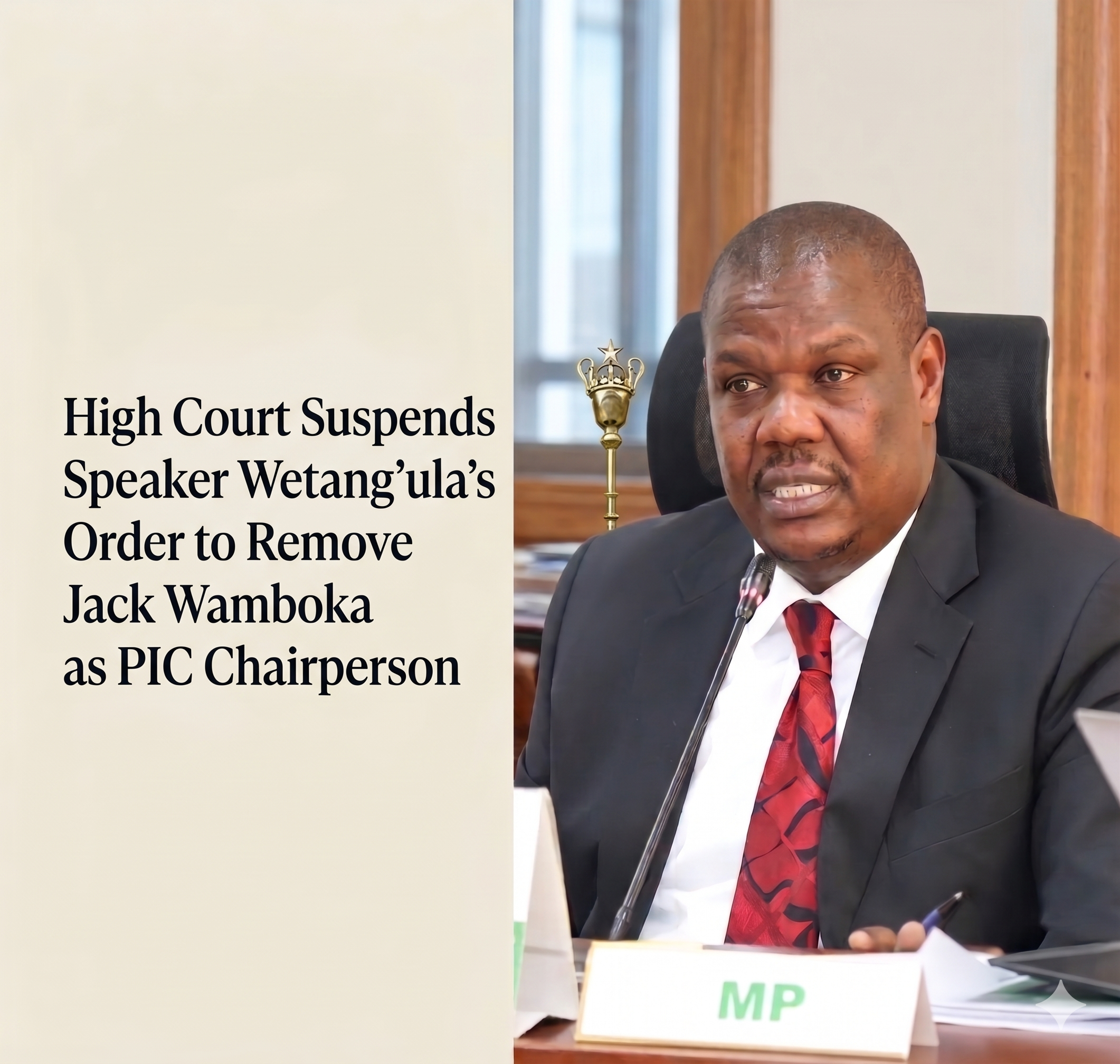
The judicial branch has once again stepped into the halls of Parliament to remind the legislature that its internal rules do not trump constitutional rights. In a decisive move, the High Court suspended National Assembly Speaker Moses Wetang’ula’s decision to strip Bumula MP Jack Wamboka of his leadership as the Chairperson of the Public Investments Committee (PIC) on Commercial Affairs and Energy. The ruling essentially freezes the Speaker’s directive, restoring Wamboka to his post pending a full review of the case.
A Breach of Natural Justice
The crux of the court’s intervention centers on the principle of due process. While the Speaker wields significant authority over the conduct of House business and the appointment of committee chairs, the court found that this power was exercised without giving Wamboka a fair hearing.
Under Article 47 of the Constitution, every person has the right to administrative action that is expeditious, efficient, lawful, reasonable, and procedurally fair. The judge observed that:
-
Wamboka was not properly notified of the specific allegations leading to his removal.
-
He was denied the opportunity to respond to the claims before the Speaker’s final decree.
-
The sudden “de-whipping” appeared to bypass the established disciplinary procedures of the House.
The Role of the PIC
The Public Investments Committee is one of the most critical watchdog organs in the National Assembly. It is tasked with auditing the accounts of state corporations, ensuring that public funds are managed with transparency and accountability. By barring Wamboka, the Speaker effectively halted the momentum of a committee currently overseeing high-stakes investigations into commercial and energy-sector parastatals.
“The Speaker’s office is the guardian of House rules, but the High Court is the guardian of the Constitution. When those two clash, the right to a fair trial will win every single time.”
What This Means for Parliament
This ruling is a clear signal that the Judiciary is prepared to act as a check on what it perceives as arbitrary decision-making within the Executive or Legislative branches. While the National Assembly often argues for “parliamentary privilege” to manage its own affairs without interference, this case reinforces that such privilege is not a license to ignore the Bill of Rights.
For now, Jack Wamboka returns to his seat at the head of the PIC table. The legal team for the National Assembly is expected to file a response, likely arguing that the Speaker acted within his administrative mandate to maintain the integrity of committee leadership. Until then, the status quo remains, and the Speaker’s “mace” has been momentarily checked by the Judge’s “pen.”
No comments yet. Be the first.